 Piezzle
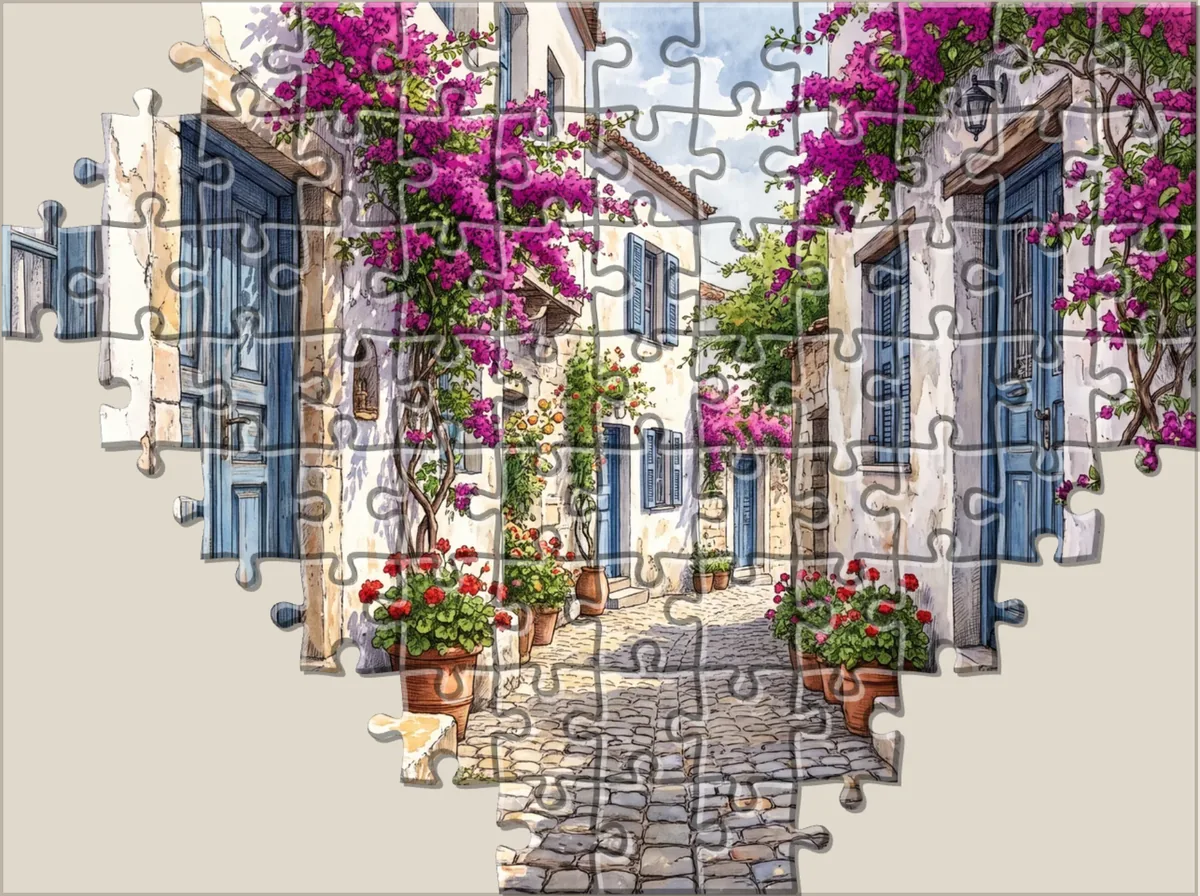
A 1000-piece puzzle is daunting when you first open the box: a pile of cardboard that all looks the same. But you don't need to be an expert to finish one. What makes the difference is having a method, and you can learn it in an afternoon. Here is the one almost every puzzler uses, step by step.
Before you start: space and light
A big puzzle will take over your table for days, so it pays to choose the spot well.
- A surface bigger than the puzzle. A 1000-piece puzzle usually measures around 70 × 50 cm (about 27 × 20 in) when finished, and you need room around it for the loose pieces. If it is a table you use every day, a board or a roll-up puzzle mat lets you put it away without undoing anything.
- Good light, ideally from above. With light from the side every piece casts a shadow and similar colours blur together. A white desk lamp makes a big difference in the evening.
- A few trays. Box lids, plates or small trays help you keep groups of pieces apart. You will need them in step 3.
Step 1: turn every piece face up
It feels like a waste of time, but it saves far more than it costs. Turn all the pieces face up and spread them out, with no piles. While you do it you are already noticing colours, textures and special pieces, and your brain starts sorting them without you noticing.
Set aside two kinds of pieces as you go: edge pieces (the ones with a straight side) and any piece with something very recognisable, like part of a face, a sign or a colour that only appears in one place.
Step 2: build the border
The frame gives you the real size of the puzzle and fixed references for everything else. Start with the four corners, which are easy to spot because they have two straight sides, and join the edge pieces by colour.
If there is a gap when you close the frame, don't worry: an edge piece hiding among the others is very common. Carry on with the rest and it will turn up.
Tip: count the edge pieces on each side. A 1000-piece puzzle is often a grid of about 36 × 28 pieces, so it has 36 on each long side, 28 on each short side and 124 edge pieces in total. That way you know how many are missing.
Step 3: sort by colour, texture and area
This is the step that turns an impossible pile into several small puzzles. Look at the picture on the box and think in areas: the sky, the water, the red roof, the white wall, the flowers… Make a group with the pieces of each area, each in its own tray.
- By colour first, the most obvious.
- By texture when colours are alike: water has reflections, wood has grain, stone is speckled, fabric has folds.
- By small details: windows, letters, the edges of objects. A line crossing a piece usually continues on the next one.
Each group becomes a mini puzzle of 50 to 150 pieces, much easier to tackle than a thousand at once.
Step 4: from easy to hard
Start with the areas that have the most contrast and detail: they come together quickly and keep you motivated. Build each area separately, close to where it goes, and join it to the frame once you have a big chunk. Objects with clear outlines (a house, a boat, an animal) make perfect anchor points.
Leave plain areas, like a clear sky or a calm sea, for the end. By then there will be fewer loose pieces and the remaining gap will tell you a lot.
Step 5: how to solve plain areas
When every piece looks the same, stop looking at the picture and look at the shape.
- Sort by shape. Group pieces by how many tabs (knobs) and blanks (holes) they have: two and two, three and one, four tabs, four blanks… When a gap needs a piece with three tabs, you only try that pile.
- Look for gradients. Even a blue sky changes tone: it is usually darker at the top and lighter near the horizon. Ordering pieces from dark to light helps a lot.
- Work row by row. Filling in row by row from an area you have already built narrows down the options for each gap.
When you get stuck
It happens to everyone: you have been at it for a while and nothing fits. A few ideas that work:
- Switch areas. Going back to something that is moving gets your rhythm back.
- Rotate the pieces. Often the right piece is right in front of you, just turned the wrong way.
- Take a real break. With fresh eyes you spot things you could not see before. It is one of the most repeated tips among puzzlers for a reason.
- Puzzle with someone. A big puzzle is perfect for sharing: one area each.
And if you puzzle on your phone or computer
A digital puzzle has its own advantages: no table needed, no lost pieces, and your game saves itself. In Piezzle the method is the same, with a few helpers you don't get on a table:
- An edge filter in the piece tray, for step 2.
- A colour filter that does much of the sorting in step 3 for you.
- A ghost image: the picture, very faint, on the board, for when you need a hint.
- Pieces snap into place when you bring them close, and you can zoom in to see the details.
New to big puzzles? Don't jump straight to 1000 pieces: try 300 or 500 first and work your way up. Our guide How many pieces should you choose? has a handy table.